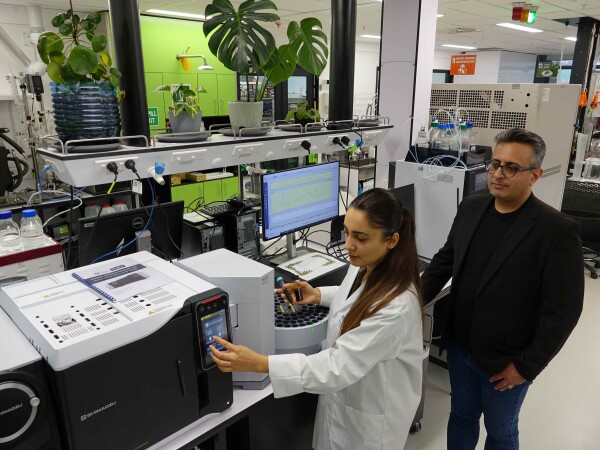
A targeted research collaboration between the University of Auckland and Road Science has removed a critical operational barrier to the wider use of BioBind, a low‑carbon bitumen replacement for road construction - by solving an issue you could quite literally smell.
Facilitated by UniServices, the collaboration focused on a specific and practical challenge encountered during production of BioBind: a strong and polarising odour generated during production. While the product itself was already technically proven, the odour raised concerns around community acceptance, and long‑term wider adoption.
Road Science had already designed and manufactured BioBind prior to the research project, so the University of Auckland’s role was clearly defined: to identify the source of the odour observed during production and to develop practical strategies to materially reduce it.
This targeted scope ensured progress enabled a fast pathway from research to implementation. Within a short timeframe, university researchers moved from problem identification to a validated, scalable mitigation solution, demonstrating how focused academic research can operate at industry pace to unlock real‑world outcomes.
Understanding the source of the odour
“The odour produced by BioBind was identified as concern for wider adoption of the product” says Professor Saeid Baroutian, who led the University of Auckland’s chemical engineering research team.
“If new materials are to succeed in the real world, they must not only perform technically - they must also be practical and acceptable to the environments they are used in.”
BioBind is engineered with renewable resources with the primary component coming from trees. It is a by‑product of pine forestry processing, meaning it is derived from forestry waste rather than crude oil, and its cutting-edge formulation boasts significantly lower embodied carbon than that of traditional bitumen. However, the inclusion of this renewable material also alters the emissions profile during heating and processing, releasing a different mix of odorous compounds.
Understanding which of those compounds were responsible for the problematic smell - and how to reduce them - became the central focus of the research.